



 print
print


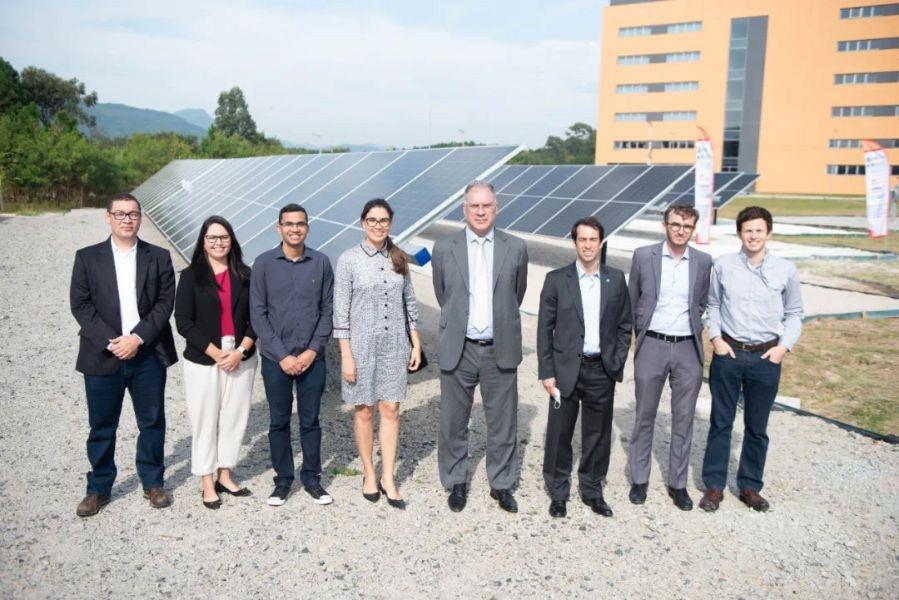
CTG Brasil inaugurated recently its Pilot Solar Plant of Bifacial Modules - capable of generating energy with direct radiation from the sun and reflected by the ground. The project was developed within the Research&Development scope of the National Electric Energy Agency (ANEEL), in partnership with the Federal University of Santa Catarina (UFSC), UNESP Ilha Solteira and SENAI, through the SENAI Institute for Energy Innovation. Renewables (ISI-ER).
The Solar Plant is located at the UFSC Solar Photovoltaic Energy Laboratory, in Florianópolis (SC), and will contribute to the development of the energy sector in Brazil by evaluating the performance of photovoltaic technology in different Brazilian soil and climate conditions.
With investments of R$ 7.2 million, the plant with solar tracking and panels that rotate around an axis, includes two types of photovoltaic modules, in four different soils, so that performance conditions can be studied throughout the seasons. year. Factors such as degradation, dirt, equipment operation in extreme irradiance and high temperature are evaluated, in addition to measurements of horizontal global irradiation, albedo, air temperature, relative humidity and wind speed. The result of the measurements will allow the realization of a plan for the implementation of future solar plants throughout the country, boosting the photovoltaic energy generation sector.
Bifacial modules have become a standard in solar projects in Brazil, mainly because they are able to produce more energy in the same space and reduce costs in their implementation, when compared to the single-sided model. “One of the biggest challenges of photovoltaic technology is the uncertainty of the performance of the plants. Therefore, the study of bifacial panels together with different types of inverters and mounted on solar trackers, applied to the climatic and operating conditions in Brazil, becomes fundamental to increase the accuracy of the operation of these plants”, explains Sergio Fonseca, director of Business Development at CTG Brasil.
The project is in line with CTG Brasil's innovation strategy, which is focused on operational excellence and asset management, in addition to identifying new opportunities that boost businesses focused on generating 100% renewable energy. “Studies like this will contribute to improving energy supply in the future, in addition to offering more competitive prices and reducing socio-environmental impacts, as they are clean energy generation projects. It is a topic that interests the whole of society”, completes Fonseca.
“With this project, we take another step towards mastering the technology and optimizing the performance of what is already the fastest growing source of electricity generation in the world”, explains Prof. Ricardo Rüther, from UFSC. “Technological advances and price reductions experienced by solar generation in the last 10 years have made this technology very competitive. It is no wonder that at the beginning of 2022, solar generation has already surpassed the mark of 1,000 GW in the world and 15 GW of installed power in Brazil. This corresponds to approximately 10% of the installed capacity of the Brazilian generating complex and exceeds the installed capacity of the Itaipu Hydroelectric Plant, our largest plant. As an ANEEL R&D Program and CTG Brasil, we are also training a large number of professionals to work with this technology in our country.”
Rodrigo Mello, regional director of SENAI in Rio Grande do Norte, the SENAI Institute for Innovation in Renewable Energies (ISI-ER) and the Center for Renewable Gas and Energy Technologies (CTGAS-ER), highlighted the impact on the sector. “This project makes a revolution in the performance of photovoltaic power generation parks. It brings an unprecedented solution to the energy market, which reduces costs, increases competitiveness and can greatly increase interest in this energy source,” said Mello.
Among the gains seen, the director highlights the increase in productivity. “From the use of a bifacial plate and the treatment given to increase the reflection of radiation, we are achieving approximately 30% increase in performance over the original productivity”, he adds, stating that “the first tests suggest that this productivity rises from 20 .8% to 27%. Teams of researchers in the areas of meteorology and engineering at the ISI, located in Natal, Rio Grande do Norte, participated in the project.
“Another point of fundamental importance in solar generation installations are inverters, electronic equipment responsible for processing the generated energy and connection between the plant and the electrical grid and essential for efficiency and longevity of operation. We intend to carry out studies to improve the useful life of the system, using information obtained in its operation, as well as analysis of failures and degradation of photovoltaic panels. With this assessment, we aim to increase the reliability and efficiency of photovoltaic plants, following the trend of accelerated technological advancement”, says Guilherme de Azevedo e Melo, professor at Unesp